


Top UV Light for Cleaning Rooms Buyers Guide
Choosing the best uv light for cleaning rooms requires more than comparing wattage, price, or attractive product claims. It requires practical judgment. Room size, surface coverage, lamp placement, exposure time, and safety controls all influence performance. A device that works well in an empty clinic may perform poorly in a furnished bedroom.
Dr. William A. Rutala, a recognized authority in healthcare disinfection, has emphasized, “No-touch disinfection technologies should be used as an adjunct to, not a replacement for, routine cleaning and disinfection.” That warning should guide every buying decision. UV-C light cannot reliably reach dust beneath furniture, shaded corners, fabric folds, or surfaces blocked by equipment. Visible cleanliness still matters.
This guide examines the features that deserve careful attention. It considers wavelength, verified irradiance, room volume, operating controls, sensor systems, and independent testing. It also discusses whether a product is suitable for occupied spaces. Direct exposure to germicidal UV-C can injure eyes and skin, so interlocks, timers, motion sensors, and remote operation are essential.
Some product descriptions sound more scientific than they are. That is a problem. Marketing language may mention “hospital-grade” results without explaining dosage or testing conditions. Buyers should ask uncomfortable questions. What organisms were tested? At what distance? For how long? Were shadows included?
A reliable choice balances disinfection goals with human safety, maintenance needs, and realistic room conditions. The strongest option is not always the most powerful lamp. Sometimes, it is the model that provides clear evidence, safer controls, and honest limitations.
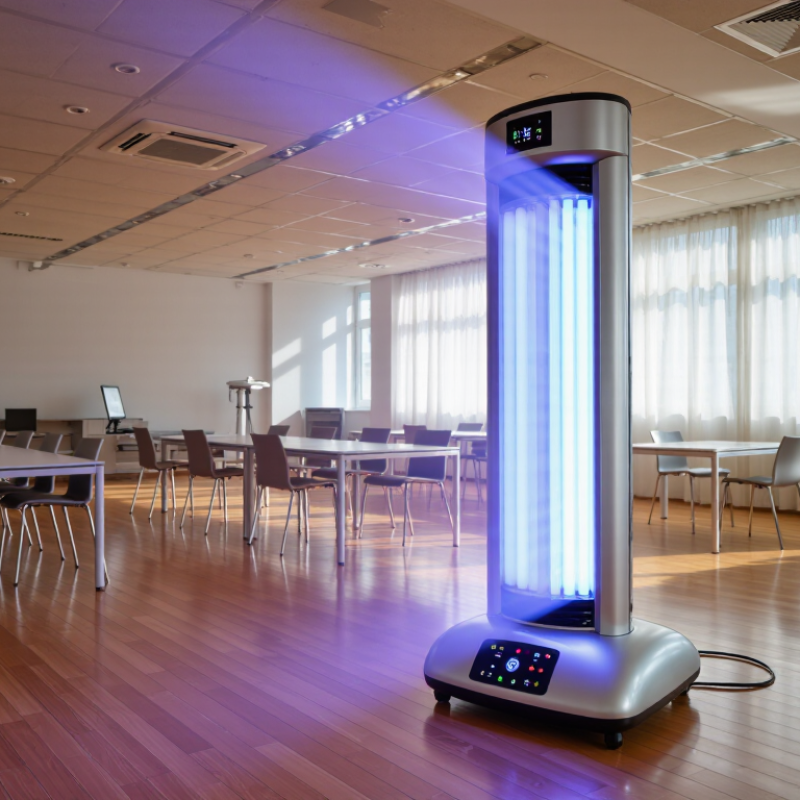
What UV Light Cleaning Is and How It Works
What UV Light Cleaning Is and How It Works
UV light cleaning uses ultraviolet-C energy, usually between 200 and 280 nanometres, to damage microorganisms’ DNA or RNA. A common low-pressure lamp emits near 254 nanometres. Some newer systems use different wavelengths. The principle is simple: stronger intensity and longer exposure create a higher UV dose. Dose equals irradiance multiplied by time.
Still, simple does not mean automatic.
The ASHRAE Handbook—HVAC Applications (2023) explains that UVGI performance depends on airflow, humidity, lamp output, and exposure time. A fast-moving air stream may receive too little energy. Dust can also shield surfaces. The Illuminating Engineering Society’s RP-44-21 recommends measuring irradiance and confirming safe installation conditions, rather than trusting wattage alone. Room size matters, but it is not the only factor.
In practical testing, a sensor should check the actual UV-C level at intended surfaces or within air-treatment equipment. CIE 155:2003 describes UV dose-response principles and shows why different organisms require different doses. Results can vary greatly. A clean metal surface near the lamp is not the same as a shaded fabric corner. Direct exposure can injure eyes and skin, so occupied-room systems require engineered shielding, controls, and professional verification. I would also question any product promising complete room sterilization. Real rooms are uneven, cluttered, and imperfect.
Top UV Light for Cleaning Rooms Buyers Guide - What UV Light Cleaning Is and How It Works
| Evaluation Dimension | What It Means | Key Facts for Buyers | Practical Room-Cleaning Considerations | Guidance |
|---|---|---|---|---|
| UV Technology | Ultraviolet light uses electromagnetic radiation with wavelengths shorter than visible light. | Germicidal ultraviolet systems generally use UV-C, especially wavelengths near 254 nm or 222 nm, depending on the lamp or excimer source and its intended application. | Confirm the actual emitted wavelength from the product documentation rather than relying only on the term “UV light.” | Check specifications |
| How Disinfection Works | UV-C can damage the nucleic acids of microorganisms, preventing them from replicating. | Effectiveness depends on the delivered UV dose, which is determined by irradiance and exposure time. | A short operating time or a powerful lamp does not automatically guarantee effective disinfection throughout a room. | Dose matters |
| Target Microorganisms | Different microorganisms have different levels of resistance to UV exposure. | Bacteria, viruses, molds, and some spores may respond differently under the same conditions. | Look for test data that identifies the organism, test method, UV dose, distance, and environmental conditions. | Review test data |
| Surface Coverage | Direct UV exposure is usually strongest on surfaces that face the light source. | UV-C has limited ability to reach shaded, covered, porous, or obstructed areas. | Furniture, bedding, fixtures, door handles, and room corners can create shadowed zones requiring repositioning or conventional cleaning. | Line of sight required |
| Room Size | The treatment area depends on lamp output, mounting position, distance, and room layout. | A stated room-size rating should be interpreted together with the required exposure time and the manufacturer’s measurement conditions. | For larger or irregular rooms, multiple positions or a professionally designed system may be necessary. | Match the coverage |
| Distance from Surfaces | UV irradiance generally decreases as the distance from the source increases. | Small changes in distance can significantly affect the dose received by a surface. | Use the recommended installation or placement distance and avoid assuming that the farthest part of the room receives the same dose. | Follow distance limits |
| Exposure Time | Exposure time is the period during which a surface or air stream receives UV energy. | Longer exposure can increase the delivered dose, but only where sufficient irradiance reaches the target. | Choose a unit with a timer, cycle indicator, or documented treatment schedule suitable for the room. | Use a controlled cycle |
| Air Treatment | UV systems can be designed to treat air as it passes through a chamber or upper-room zone. | Air disinfection performance depends on airflow rate, UV intensity, mixing, residence time, and system design. | Air-treatment units should not be judged solely by surface-cleaning claims. Ventilation and filtration remain important. | Verify airflow data |
| Ozone Generation | Some UV sources can generate ozone when they emit wavelengths below approximately 240 nm. | Ozone is a respiratory irritant, and its production depends on the source design and operating conditions. | Check whether the device is ozone-producing, ozone-free, or independently tested for ozone emissions. Ventilate as required. | Check ozone information |
| Human and Animal Safety | Direct exposure to germicidal UV-C can injure eyes and skin. | Conventional germicidal UV-C devices should not operate in occupied rooms unless specifically designed and validated for safe occupied use. | Remove people, pets, and plants when required; use interlocks, motion sensors, warning indicators, and access controls where applicable. | Do not expose occupants |
| 222 nm Systems | Some far-UVC systems use filtered wavelengths around 222 nm and are designed for different safety conditions. | Safety depends on the exact wavelength, filtration, exposure limits, installation, and compliance testing. | Do not assume every 222 nm product is safe for occupied spaces. Require independent safety and performance documentation. | Require validation |
| Material Compatibility | Repeated UV exposure can degrade or discolor certain plastics, rubber, fabrics, coatings, and artwork. | Damage risk varies with wavelength, dose, material composition, exposure frequency, and surface condition. | Check compatibility before treating sensitive equipment, textiles, photographs, finishes, or medical materials. | Test sensitive materials |
| Cleaning Before UV Use | Soil, dust, organic residue, and biofilm can shield microorganisms from UV light. | UV is generally a supplementary disinfection method, not a replacement for removing visible dirt. | Clean surfaces first, then use UV as an additional treatment when appropriate and safe. | Clean first |
| Controls and Interlocks | Safety controls help prevent accidental exposure during operation. | Useful features may include delayed start, remote operation, door interlocks, motion detection, occupancy sensing, and automatic shutoff. | For rooms accessed by multiple people, prioritize systems that provide clear status indicators and reliable access control. | Prioritize safeguards |
| Performance Documentation | Independent testing helps verify claims about UV output and microbial reduction. | Useful documentation identifies the test organism, UV dose, distance, exposure time, test surface, and measurement method. | Be cautious of claims that provide only a percentage reduction without test conditions or a defined treatment area. | Demand evidence |
| Maintenance | Dust, aging lamps, damaged filters, and contaminated reflectors can reduce output. | Some lamps lose useful UV output over time even when they continue to produce visible light. | Follow the cleaning, lamp-replacement, filter-replacement, and output-check schedule in the technical documentation. | Maintain regularly |
| Best Use Case | UV systems are most suitable when controlled exposure, clear room access, and measurable treatment conditions are available. | They may supplement routine cleaning, ventilation, filtration, and hygiene procedures. | Choose a system based on the room’s purpose, occupancy pattern, surfaces, layout, and required safety controls. | Use as a supplement |
| Buyer’s Final Checklist | A practical evaluation should combine safety, performance, coverage, and operating cost. | Confirm wavelength, irradiance or dose data, room coverage, cycle time, safety controls, ozone information, maintenance needs, warranty terms, and applicable compliance documentation. | Compare products using the same test conditions and avoid selecting solely by lamp wattage or advertised room size. | Compare complete specifications |
Related Posts
-
Top Benefits of Using a UVC Sterilizer for Home and Health?
-
2026 Best Pulsed UV Disinfection Solutions for Global Buyers?
-
Why Choose a UVC Machine for Global Sourcing?
-
10 Best UVC Sterilisers Which One Should You Buy?
-
10 Best UV Light Decontamination Methods You Should Know?
-
Why Choose UV Light Cleaners for Hospitals in China?