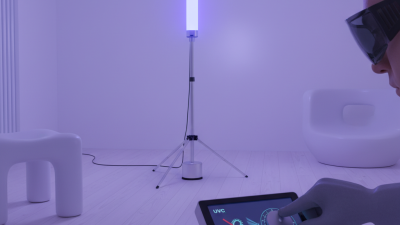
| UV-C source band |
Use a documented germicidal UV-C output, commonly within approximately 200–280 nm. The exact wavelength, optical output, and operating distance must be stated by the manufacturer. |
Request an independent or calibrated spectral measurement, lamp or LED specifications, and the effective treatment distance. |
Performance-critical
Wavelength alone does not establish room-level microbial reduction. |
| Photobiological safety |
Evaluate ultraviolet, actinic-ultraviolet, and ocular exposure hazards using the risk-group methodology of IEC 62471. |
Obtain an IEC 62471 test report identifying the applicable risk group, measurement conditions, accessible emission, and exposure limits. |
Required safety evidence
IEC 62471 is a photobiological safety assessment standard, not a claim of disinfection effectiveness. |
| Human exposure control |
Direct UV-C exposure to occupied-room personnel and patients should be prevented unless the specific application has been evaluated for safe exposure. |
Confirm that the operating procedure requires room vacancy, controlled access, warning signs, and a documented re-entry process. |
Patient and worker protection
UV-C can injure skin and eyes, including through reflected radiation. |
| Physical shielding |
Use enclosed chambers, baffled designs, fixed shields, or other engineering controls that prevent line-of-sight access to active UV-C sources. |
Inspect the device for gaps, removable panels, exposed lamps, reflective surfaces, and leakage under normal and foreseeable misuse conditions. |
Engineering control
Administrative warnings should not be the only protection where exposure is reasonably foreseeable. |
| Door and panel interlocks |
Access doors, covers, and service panels should interrupt UV-C emission when opened or removed. |
Test every interlock during commissioning and after maintenance. Verify that the system cannot automatically restart while an access point is open. |
Required for enclosed equipment
Interlocks should be fail-safe and resistant to easy bypass. |
| Room-entry interlock |
For whole-room UV-C systems, use a controlled start sequence that confirms the room is vacant and prevents unauthorized entry during treatment. |
Verify door sensors, motion or occupancy detection where provided, emergency stop controls, audible or visual warnings, and access-control integration. |
Strongly recommended
A room-entry control should complement, not replace, staff procedures. |
| Emergency stop |
Provide a clearly marked, readily accessible emergency stop that immediately terminates UV-C emission. |
Check the stop location, reset method, visibility, response time, and whether the device requires a deliberate restart after an emergency stop. |
Operational safeguard
Emergency controls should be included in staff training and functional checks. |
| FDA-related review |
Review applicable U.S. Food and Drug Administration guidance and labeling related to UV-C radiation, exposure hazards, intended use, and medical-device status. |
Confirm the intended-use statement, U.S. regulatory pathway or listing information when applicable, warnings, contraindications, and supporting test documentation. |
Regulatory due diligence
FDA information does not remove the need for facility risk assessment or safe operating procedures. |
| Disinfection claim evidence |
Claims should identify the test organism, surface type, UV-C dose or irradiance, distance, exposure time, environmental conditions, and reduction method. |
Request complete laboratory protocols and results rather than relying only on a stated percentage reduction. |
Evidence-based purchasing
Results for exposed, clean laboratory surfaces may not predict performance on shadowed or soiled room surfaces. |
| Dose monitoring |
Prefer systems that measure or estimate delivered UV-C dose using calibrated sensors, validated positioning, or a documented exposure model. |
Verify sensor calibration intervals, dose calculation assumptions, error handling, and whether the system records completed cycles. |
Recommended
Cycle time alone is not a reliable substitute for delivered dose. |
| Shadowing and room geometry |
Evaluate line-of-sight limitations caused by beds, equipment, furniture, curtains, corners, and other obstructions. |
Review room maps, lamp placement, required repositioning steps, and any validated coverage zones. |
Clinical-use consideration
UV-C is primarily an exposed-surface treatment and may not reach shaded areas. |
| Surface compatibility |
Assess repeated UV-C exposure for plastics, elastomers, fabrics, coatings, labels, and medical equipment located in the treatment area. |
Request material-compatibility data and inspect high-use surfaces for discoloration, cracking, embrittlement, or loss of markings. |
Lifecycle risk
Material damage can create replacement costs and additional infection-control risks. |
| Ozone and secondary emissions |
Where applicable, evaluate ozone generation and other emissions associated with the UV source or device design. |
Check the source spectrum, ozone test results, ventilation requirements, and re-entry controls. Do not assume that every UV-C device is ozone-free. |
Environmental safety
Re-entry criteria should account for any emitted ozone or other hazardous by-products. |
| Lamp or LED aging |
Account for output reduction over service life, including lamp aging, LED degradation, contamination, and optical fouling. |
Verify rated service life, output-maintenance data, replacement instructions, cleaning requirements, and end-of-life alarms. |
Performance assurance
A device may complete a timed cycle while delivering less UV-C than expected. |
| Maintenance and calibration |
Establish documented inspection, cleaning, lamp replacement, sensor calibration, and electrical-safety checks. |
Confirm availability of service procedures, maintenance records, calibration certificates, and authorized repair instructions. |
Quality-system control
Maintenance status should be traceable for each device and treatment cycle. |
| Electrical and mechanical safety |
Assess electrical protection, grounding, cord management, stability, mobility, thermal management, and resistance to tipping or impact. |
Review applicable electrical safety certifications and perform a site-specific inspection before clinical deployment. |
General equipment safety
UV-C performance does not substitute for electrical, fire, and mechanical safety review. |
| Hospital workflow integration |
Use UV-C only after routine cleaning and according to the facility infection-prevention protocol. |
Define responsibility for room release, device placement, cycle selection, failed-cycle response, and final room sign-off. |
Process control
UV-C should be treated as a supplementary environmental-control measure, not a replacement for manual cleaning. |
| Training and records |
Provide role-based training covering hazards, room clearance, controls, emergency stop use, maintenance, and incident reporting. |
Maintain operator competency records, treatment logs, failed-cycle reports, maintenance history, and exposure-incident procedures. |
Recommended governance
Documented use supports auditability and continuous improvement. |