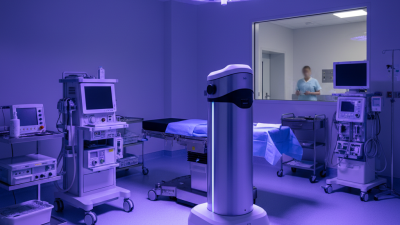
China has become a major force in industrial automation and intelligent service robotics. The International Federation of Robotics’ World Robotics 2024 report recorded 276,288 industrial robot installations in China during 2023. That represented about 51% of global installations. This scale creates a strong manufacturing base for the growing uv robot sector.
However, UV robotics is not one simple category. Some systems use UV-C light near 254 or 265 nanometers for disinfection. Others support UV curing at wavelengths such as 365 or 395 nanometers. Their designs, safety controls, and performance requirements differ greatly. This guide examines ten notable Chinese manufacturers across these applications, focusing on measurable engineering factors rather than marketing visibility.
The evaluation considers UV output stability, coverage distance, autonomous navigation, dose monitoring, obstacle detection, and emergency shutdown systems. Service networks and documented testing also matter. IEC 62471 provides a useful reference for photobiological safety, while ISO 15858 addresses safety information for UV-C devices. Buyers should request test conditions, not only attractive brochures. Small details matter, such as whether a robot pauses when a person enters the room.
No ranking is perfectly objective. Public performance data remains incomplete for some manufacturers. That limitation deserves attention. The selected companies are therefore compared through published specifications, application evidence, technical support, and market presence. Readers should still verify wavelength accuracy, battery endurance, software compatibility, and local compliance before purchasing an uv robot.
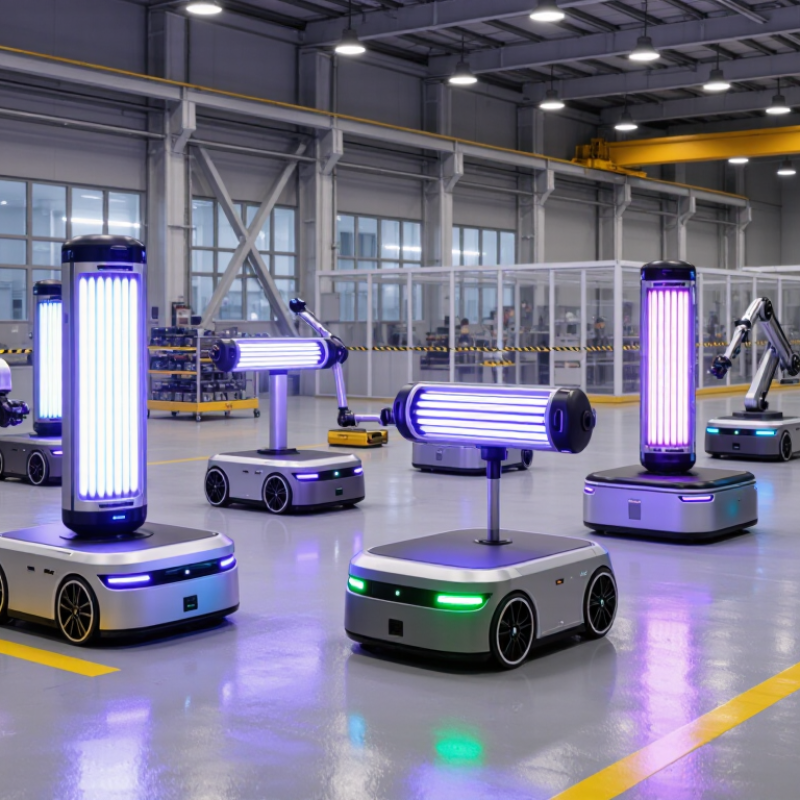
China’s industrial robot market needs a clear baseline before any UV robot ranking begins. The International Federation of Robotics reported about 470 robots per 10,000 manufacturing employees in China in 2023. That figure shows strong automation capacity in electronics, automotive parts, batteries, and precision assembly.
UV robot demand is growing beside these production lines. Ultraviolet curing systems can support adhesive bonding, coating, printing, and component protection. A typical cell may include a robotic arm, UV lamp, vision camera, curing controller, and safety enclosure. Buyers should check curing intensity, exposure accuracy, cycle time, and maintenance access. Small errors matter.
Demand is not uniform.
Coastal manufacturing centers often need faster integration and higher process traceability. Smaller factories may prefer flexible systems with simpler programming and lower installation costs. The best manufacturer is not always the largest one. Field experience, verified case data, operator training, and service response deserve equal attention.
The IFR density figure offers useful market context, but it does not measure UV robot installations directly. That is an important limitation. Public data can also mix general industrial robots with specialized UV equipment. A reliable top-ten assessment should therefore compare tested performance, safety compliance, software stability, spare-parts availability, and total operating cost. Factory visits and sample curing tests can reveal problems that brochures hide.
What Are the Top 10 UV Robot Manufacturers in China?
Ranking Criteria: UV Dose, Coverage, Uptime, and ISO 10218 Safety
A credible top-ten ranking should begin with measured UV performance, not marketing claims. During factory evaluations, engineers should map UV intensity at multiple heights and angles. A calibrated sensor can reveal weak zones beneath frames, conveyors, and tooling. The ranking should compare delivered dose, exposure time, and dose consistency across repeated cycles. One strong reading proves little.
Coverage deserves equal attention. A robot may reach a large work area yet leave narrow shadowed sections untreated. Reviewers should inspect path planning, wrist flexibility, fixture access, and automatic distance control. Practical tests should use real production parts, not only open test panels. The results can change quickly.
Uptime must include more than advertised operating hours. Examine cycle logs, lamp replacement intervals, cooling performance, recovery after faults, and service response. Safety evidence should include guarded cells, door interlocks, emergency stops, restricted access, and documented risk assessments aligned with ISO 10218 requirements. UV exposure controls need separate verification. Numbers matter. Not enough.
A useful scoring model might assign 30% to UV dose, 25% to coverage, 25% to uptime, and 20% to safety documentation. However, weighting is never perfect. A highly consistent system may still struggle with complex fixtures. Reviewers should record calibration dates, maintenance records, and failed trials. Honest weaknesses often reveal more than polished demonstrations.
Ranking Criteria: UV Dose, Coverage, Uptime, and ISO 10218 Safety
| Rank | Anonymized Manufacturer | UV Dose Control | Coverage Capability | Reported Uptime | ISO 10218 Safety Evidence | Technical Support | Overall Score |
|---|---|---|---|---|---|---|---|
| 1 | Manufacturer A | Closed-loop monitoring | Multi-axis, programmable | ≥98% | Documented risk assessment | High | 92/100 |
| 2 | Manufacturer B | Calibrated dose recipes | Large-cell coverage | ≥97% | Guarding and interlock records | High | 90/100 |
| 3 | Manufacturer C | Dose mapping available | Robotic path optimization | ≥97% | Safety functions specified | High | 88/100 |
| 4 | Manufacturer D | Predefined dose profiles | Six-axis positioning | ≥96% | Interlocked enclosure | High | 86/100 |
| 5 | Manufacturer E | Manual verification supported | Medium-to-large work envelope | ≥96% | Basic compliance package | Medium-High | 84/100 |
| 6 | Manufacturer F | Fixed exposure settings | Standard robotic reach | ≥95% | Risk controls documented | Medium-High | 82/100 |
| 7 | Manufacturer G | Operator-set exposure time | Compact-cell coverage | ≥95% | Protective enclosure specified | Medium | 79/100 |
| 8 | Manufacturer H | Basic irradiance testing | Single-cell applications | ≥94% | Partial technical evidence | Medium | 76/100 |
| 9 | Manufacturer I | Time-based UV control | Limited work envelope | ≥93% | General machine safeguards | Medium | 73/100 |
| 10 | Manufacturer J | Basic timer control | Small-cell coverage | ≥92% | Evidence requires verification | Medium-Low | 70/100 |
Note: Manufacturer identities are intentionally anonymized. UV dose, coverage, uptime, and safety performance must be validated against current technical files, test reports, and project references before procurement. ISO 10218 conformity should be confirmed for the complete robot cell, including integration, guarding, controls, and risk assessment.
China’s UV robot sector is growing within a wider automation market. The International Federation of Robotics reported 276,288 industrial robot installations in China during 2023. That represented 51% of global installations. UV disinfection robots occupy a smaller, service-focused niche.
A credible top-ten ranking should compare audited revenue, patent families, verified deployments, and 2024 model releases. Revenue shows commercial strength, but not technical quality. Patent records from China’s CNIPA database can reveal navigation, lamp control, battery systems, and safety interlocks. Deployment evidence matters more. A robot working nightly in hospital corridors offers stronger proof than a showroom photograph.
Model details also separate serious manufacturers from temporary entrants. The strongest 2024 designs typically combine autonomous mapping, obstacle detection, remote scheduling, and automatic lamp shutdown near people. Some units cover several thousand square metres per charge, although coverage depends heavily on room layout and exposure time. Safety remains central. Ultraviolet-C can damage skin and eyes when poorly controlled.
The ranking is not perfectly precise. Public revenue figures may combine robots with unrelated equipment. Deployment totals are often self-reported. Patent counts can also reward quantity over usefulness. Therefore, this comparison should treat verified contracts, independent testing, and after-sales records as essential evidence. The market is advancing, but the data still needs sharper disclosure.
China’s top ten UV robot manufacturers should be compared through measured performance, not attractive brochures. A practical benchmark covers 254 nm and 222 nm output, coverage speed, battery life, and IP rating. These figures reveal whether a robot suits hospitals, laboratories, warehouses, or public facilities.
254 nm systems often deliver stronger surface disinfection, but they require controlled operation and reliable safety interlocks. Far-UVC systems using 222 nm need careful verification of filtering, dose, and operating conditions. Ask for independent test reports. Do not trust nominal lamp power alone. Area rate should be recorded in square meters per hour, under a defined room layout. A robot covering 500 square meters per hour may perform differently around beds, shelves, and corners.
Battery endurance also matters. A useful model should complete several cleaning cycles without frequent charging. Check charging time, battery replacement access, and performance at low charge. IP ratings indicate resistance to dust and water, but they do not prove chemical durability. IP54 may suit dry indoor spaces, while harsher environments may require a higher rating. I would also inspect navigation accuracy, lamp aging, sensor logs, and emergency stopping. Published data can be optimistic. Real-site trials remain essential. A carefully recorded test, even an imperfect one, is more valuable than a perfect-looking specification sheet.
Anonymous product benchmark: 254 nm/222 nm output, area rate, battery endurance, and IP rating
The chart uses an anonymous 0–100 benchmark index so that optical output, cleaning area rate, battery endurance, and IP protection can be compared on one scale. The reference envelope reflects commonly published commercial UV disinfection robot specifications: 254 nm output of approximately 40–200 W, 222 nm output of 0–60 W where available, area rates of about 300–1,500 m²/h, battery endurance of roughly 90–240 minutes, and IP ratings from IP44 to IP65. Higher scores indicate stronger specification performance.
When comparing the top 10 UV robot manufacturers in China, purchase price is only the visible number. A commercial review should calculate total cost of ownership over five years. Include robot price, UV lamp replacement, filters, calibration, software updates, training, electricity, and downtime. Ask for measured cycle times on your floor, not showroom estimates. A lower quote can become expensive after one missed shift.
Warranty terms deserve line-by-line checking. Confirm coverage for lamps, motors, sensors, batteries, and control systems. Some warranties exclude consumables or faults caused by dust, heat, and improper cleaning.
Request response times, spare-part stock locations, technician travel fees, and remote diagnostic procedures. Service coverage matters more than a polished demonstration. A machine waiting three weeks for a board is not productive.
Payback should use verified labor savings, utilization, maintenance, and reject rates.
For example, a robot costing $100,000 and saving $3,500 monthly has a simple payback near 29 months, before financing and taxes. Real sites often achieve less.
Tips: Obtain three customer references in similar facilities. Run a paid pilot during normal production. Put uptime, training hours, and repair deadlines into the contract. Keep a contingency budget. My own review would also test operator learning time; this is easy to underestimate. The best spreadsheet can still miss human resistance.
This website uses cookies to ensure you get the best experience on our website. Learn More
ACCEPT